Weather conditions and avalanche risk
Checking the weather conditions is the first compulsory step in preparing for a summit outing. Conditions in the high mountains can change in a matter of hours. An early morning blue sky can very quickly give way to weather that reduces visibility to zero.
Before putting on your skis for a session, check the official mountain weather forecasts on www.meteofrance.com/meteo-montagne/alpes-du-nord. These forecasts provide information on temperatures at altitude, wind strength and direction, expected precipitation and the evolution of the snowpack.
Important information: The snow forecast is just as essential as the weather forecast. The Bulletin d’Estimation du Risque d’Avalanche (BRA), published daily by Météo France for each mountain range, analyses the stability of the snowpack and identifies the most dangerous slopes according to their orientation and altitude. It is important not to overlook these factors. Consult the BRA at www.meteofrance.com/meteo-montagne/alpes-du-nord/risques-avalanche
Points to check systematically:
- Weather and snow forecasts: Check the latest official bulletins
- Avalanche risk: Check today’s risk scale for your area
- Visibility and orientation: Make sure you can find your way around in fog.
The latest weather information for Belledonne and Chartreuse
Analysis of the terrain and itinerary
Knowledge of the terrain is a decisive factor in off-piste skiing safety. Setting off on an adventure without studying your route can be risky.
Before you set off, study the route you want to take on a detailed topographical map or via specialist applications. Identify the steep slopes likely to trigger avalanches (generally those with a gradient of more than 30 degrees). Look out for rock bars, ledges and areas of snow accumulation.
Preparing an off-piste route also includes identifying escape routes and safety zones. Consult the guidebooks and talk to the local mountain guides and first-aid instructors, who know exactly how the terrain and snow conditions are evolving. If all this information is not clear to you, seek professional help.
The key questions to ask yourself:
- Do you know the profile of the terrain? Have you been there before?
- What are the steepest slopes and where do they face?
- Where do the wind-driven snow accumulate?
- What are the alternative routes in case of problems?
- Have local conditions changed since your last visit?
 Visu Newsletter 3
Checking safety equipment
Safety equipment represents your chances of survival in the event of burial. The DVA-shovel-probe trio is compulsory for all off-piste skiing. But having this equipment is not enough: check it regularly and learn how to use it properly.
The DVA (Détecteur de Victimes d’Avalanche – Avalanche Victim Detector) emits a radio signal to locate a buried person. Check the batteries before each outing (weak batteries reduce the range). Practise regularly: in an emergency, you won’t have time to consult the instructions.
The shovel must be sturdy enough to dig through compact snow. A probe (minimum 2.40 m) will pinpoint the victim’s exact location before digging, saving you precious time.
Essential equipment to take with you:
- avalanche transceiver with new/charged batteries
- Sturdy snow shovel
- Probe minimum 2.40m (ideally 3m)
- Avalanche airbag (highly recommended)
- Ski helmet (essential)
- First aid kit
- Charged telephone (112 number)
- Signal whistle
- Headlamp with spare batteries
Assessing the human factor and the group's skills
The human factor is also important. Over and above the weather conditions, it’s the group’s ability to make the right decisions that determines your safety.
Makeanhonest assessment of your physical condition and technical level. Are you fit enough for several hours at altitude? Can you handle all types of snow? Do you have the experience to interpret danger signs?
Self-evaluation essential:
- Physical ability: fitness, sleep, acclimatisation
- Technical ability: Level of skiing suited to the route
- Experience: Knowledge of off-piste skiing and risk management
- Group dynamics: Who decides? Who has the most experience?
Golden rule: Adapt the route to the level of the least experienced skier, never to the ambitions of the most daring. Define roles clearly: who leads the way and who leads the way back.
DVA FUNCTION TEST PROTOCOL
The collective avalanche transceiver test is the last safety net before setting off. This few-minute ritual can change everything in the event of an avalanche.
1) Each skier turns on their avalanche transceiver in transmit mode.
2) A member of the group goes in front of everyone in search mode.
3) Check that all signals are being received
4) Reminder of safety instructions and emergency procedures
 11
11Safety distances
- Uphill: Minimum 10m between skiers
- Downhill: 1 skier at a time on slopes > 30°.
- Never cross a suspect slope in a compact group.
Understanding avalanche risk
 Visu Newsletter 14
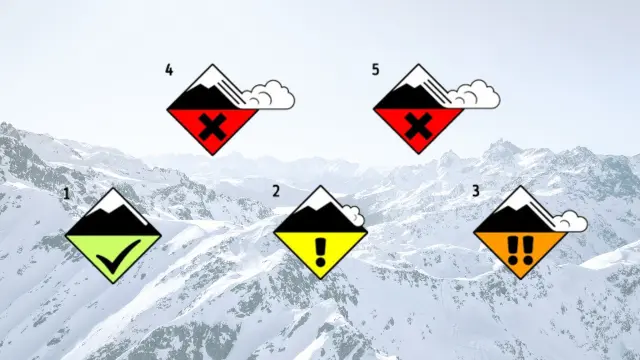
The Bulletin d’Estimation du Risque d’Avalanche (BRA) is published daily by Météo France. This European scale of 1 to 5 is not linear: going from 2 to 3 represents a major qualitative change. The majority of accidents occur at risk 3, because skiers still go out in large numbers while underestimating the dangers.
🟢 Level 1 – LOW
- Snowpack well stabilised almost everywhere
- Unlikely to trigger, isolated patches possible
- Spontaneous avalanches rare and small
- Caution nevertheless on very steep slopes
🟡 Level 2 – LIMITED
- Mantle moderately stabilised on most terrain
- Possible triggering on unfavourable steep slopes
- Large-scale avalanches unlikely
- Most frequent level in season
- Avoid slopes identified as dangerous in the ARO
🟠 Level 3 – MARKED
- Significant instability on many slopes
- Likely to trigger even with low overload (1 skier)
- Average spontaneous avalanches possible
- Critical threshold: advanced skills required
- Many fatal accidents at this level
🔴 Level 4 – STRONG
- Mantle weakly stabilised on most steep slopes.
- Triggers very likely, even with low overload.
- Large spontaneous avalanches expected
- We strongly advise against going out
- Reserved for professionals with very selective itineraries
⚫ Level 5 – VERY STRONG
- Widespread instability of the snowpack
- Numerous spontaneous avalanches on a very large scale
- Exceptional situation of maximum avalanche activity
- Do not go out – Major danger
In the event of an avalanche
- Trigger your airbag if so equipped
- Shout to alert the group
- Try to stay on the surface by swimming
- Create an air pocket in front of your face if buried
- Keep your energy up and stay calm
If you are a witness :
- Memorise where the victim has disappeared to
- Call 112 immediately
- Switch ALL avalanche transceivers to search mode
- Organise the search methodically
- Once located: probe, dig and clear the airways
Nota Bene: mountain rescue can have a considerable financial cost. Don’t forget your insurance!